Trust and Transparency
Provenance Disclosure
Mark which parts of a document were generated by AI, edited by a person or written by a person.
Overview
Once AI text is pasted into a document, it's indistinguishable from the rest, so reviewers can't tell what a person checked. Provenance Disclosure shows the origin of each block (AI, AI edited by a person, or written by a person) and carries machine-readable credentials, such as C2PA content credentials, when the content leaves the tool.
When to use
Use when
- AI generates content inside documents, reports or media that people edit, approve or publish.
Where the rules aren't clear yet
Minor assistive edits, like spelling or formatting, are excluded: the EU AI Act marking duty doesn't cover assistive editing that doesn't substantially change the input. But no legal or descriptive threshold exists for how much human editing changes the label. Is it enough if a user deletes an em dash, or rewrites the sentence? The system has no rule to decide when AI-generated content no longer needs labelling.
Questions to ask
Ask these at kickoff, when design work starts. Tick them off as your team answers.
Future exploration
Can the tool track origin per block or input, and mark which AI output a person has reviewed?
How other systems do it
One publishing platform asks creators to declare AI use in detail, and shows how the editing question can be handled in practice.
Amazon Kindle Direct Publishing
When publishing a book, authors answer separately for texts, images and translations. For each, they say how much was AI-generated (some sections or the entire work; one, a few or many images) and whether it was edited minimally or extensively, and they name the tools used. Amazon treats content as AI-generated even when it was extensively edited afterwards. The declaration is internal to Amazon: it doesn't appear on the book's product page, so readers never see it.
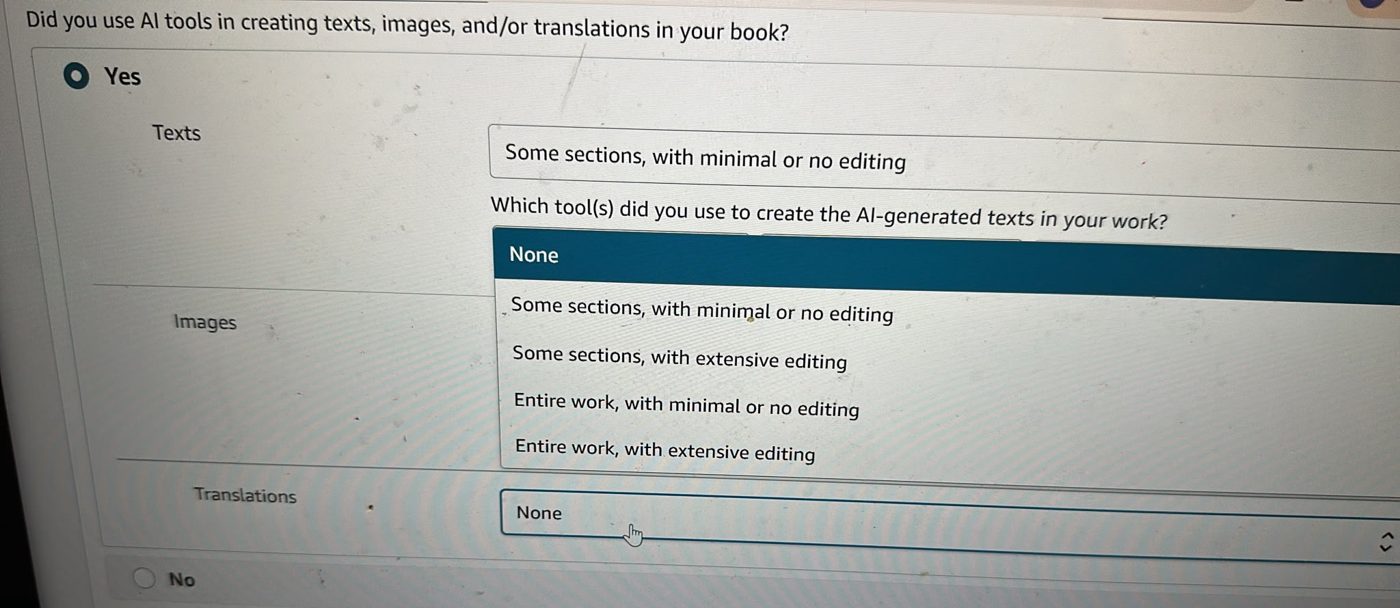
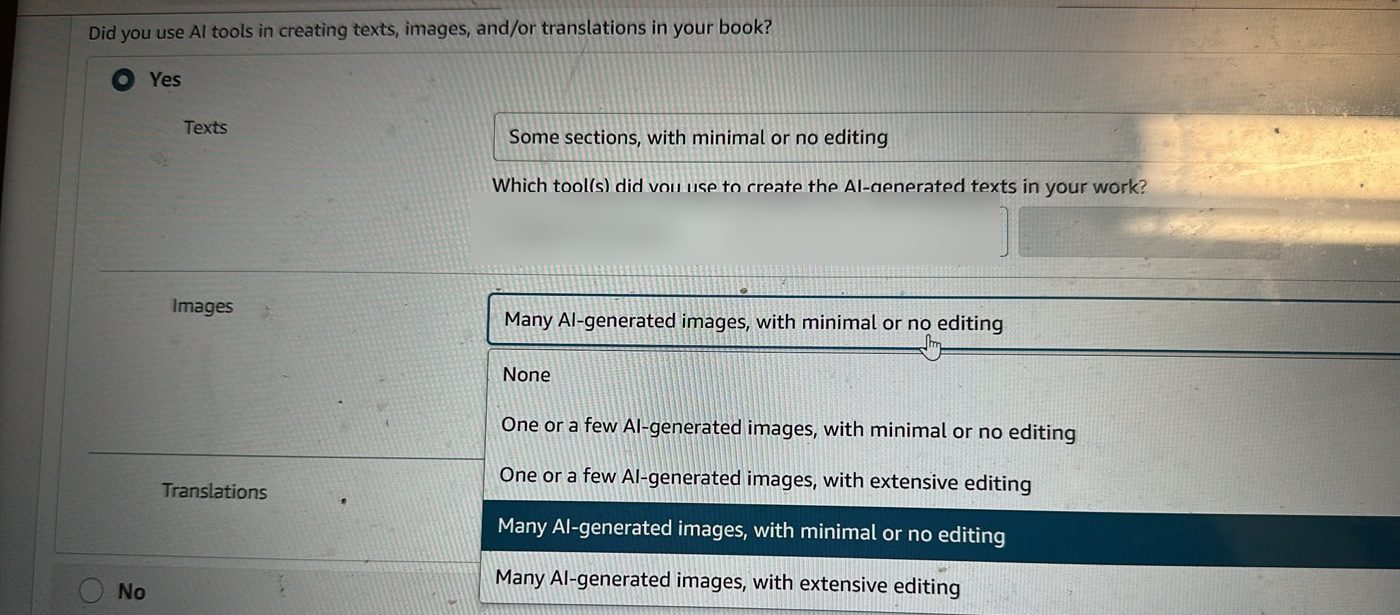
What this shows: a structured answer to “how much editing?” that the creator chooses themselves, so the system doesn't have to judge it. It also shows the gap: the declaration stops before it reaches the reader.
Anti-patterns to pay attention to
- AI-generated content loses its origin when you edit or paste it.
- Reviewers can't see which passages are AI-generated and unreviewed.
References
Current guidelines · EU AI Act2 references
For orientation only, not legal advice. These obligations apply beyond high-risk systems. EU AI Act links open a readable version of the official text published on EUR-Lex; ISO/IEC 42001 is a paid standard.
- EU AI Act Art. 50(2) Providers of systems that generate synthetic audio, image, video or text must mark outputs in a machine-readable format so they're detectable as AI-generated, with an exception for assistive editing.
- EU AI Act Art. 50(4) Deployers must disclose deepfakes, and AI-generated text published to inform the public on matters of public interest, unless it has had human review and editorial responsibility.